
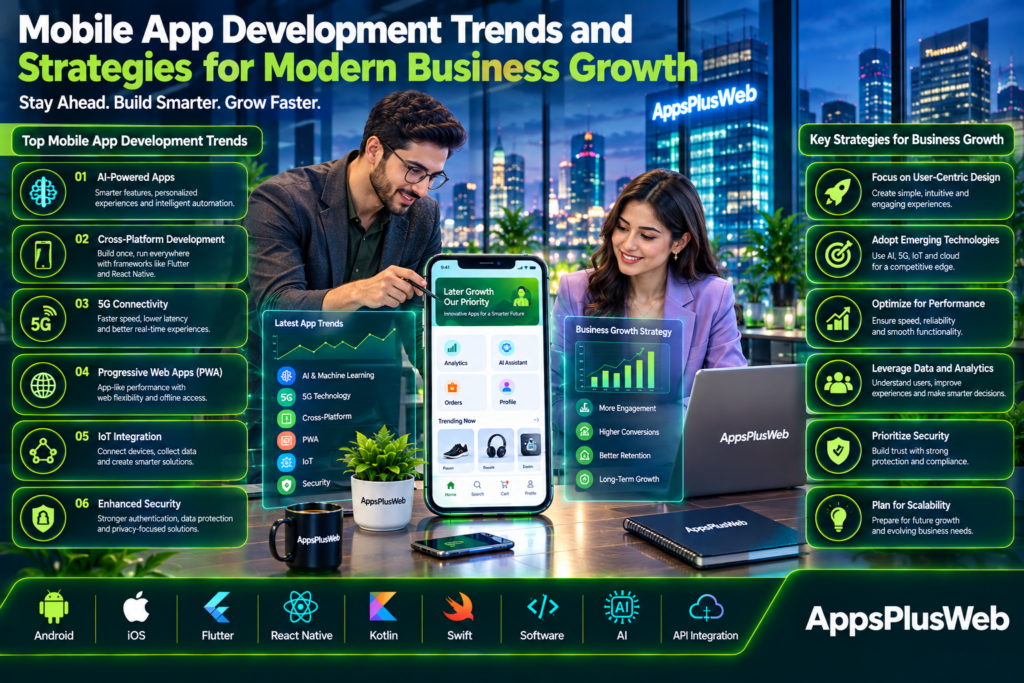
Mobile applications have become an important part of the modern business ecosystem. Customers increasingly use smartphones to discover products, access services, communicate with businesses, make payments, and manage everyday activities. For businesses, this creates an opportunity to build direct digital connections while improving customer experiences and operational efficiency.
As technology continues to evolve, businesses need mobile applications that are useful, secure, scalable, and prepared for changing customer expectations. Working with an experienced mobile app development company can help organizations transform their ideas into practical digital products while selecting technologies and features that support their long-term objectives.
Understanding current development trends is equally important. Artificial intelligence, cloud technology, cross-platform development, personalization, digital payments, location-based services, and stronger security are influencing how businesses approach mobile applications.
Why Mobile Apps Matter for Modern Businesses
A mobile application can create a direct communication channel between a business and its customers. Instead of depending only on traditional websites or physical interactions, companies can provide services through an application that remains easily accessible on smartphones.
Mobile apps can support many business activities, including online shopping, bookings, customer support, loyalty programs, education, healthcare services, financial transactions, logistics, and internal business operations.
Businesses can also use applications to improve customer engagement by providing personalized content, timely notifications, convenient services, and simplified user journeys.
For growing companies, an application can become more than a customer-facing platform. It can also connect with internal systems and help automate processes, manage information, and provide useful business insights.
AI-Powered Mobile Applications
Artificial intelligence is becoming an important technology for modern mobile applications. Businesses can use AI to make applications more intelligent, responsive, and personalized.
AI-powered recommendation systems can analyze user activity and suggest relevant products, services, or content. Intelligent chatbots can provide quick responses to common customer questions, while AI-based analytics can help businesses understand user behavior.
AI can also support automation. For example, applications can use intelligent systems to categorize information, identify patterns, assist customer service teams, or provide personalized recommendations.
The most effective approach is to use AI where it creates meaningful value. Businesses should first identify customer or operational challenges and then select AI capabilities that directly address those needs.
Cross-Platform App Development
Businesses often want to reach customers across both Android and iOS devices. Developing separate applications for every platform can require additional resources, depending on the project’s complexity.
Cross-platform technologies such as Flutter and React Native provide an alternative development approach. They allow businesses to build applications that can operate across multiple platforms while sharing a significant portion of the development structure.
This approach can help businesses manage development resources efficiently and maintain a consistent user experience.
However, technology selection should always depend on project requirements. Performance expectations, integrations, application complexity, design requirements, and future expansion should be evaluated before choosing a development framework.
Personalized User Experiences
Customers increasingly expect digital experiences that are relevant to their individual needs. Personalization can help businesses create more meaningful interactions within a mobile application.
Applications can use information such as preferences, previous activity, purchase history, or location to provide relevant content and recommendations.
An eCommerce platform may suggest products based on previous browsing behavior. A learning application can recommend courses according to a user’s interests, while a service platform can highlight frequently used services.
Personalization should be implemented carefully with appropriate privacy practices. When customers receive useful information without unnecessary complexity, the application can become more valuable and engaging.
Cloud-Based Mobile Applications
Cloud technology provides businesses with flexible infrastructure for modern applications. Cloud-based systems can support data storage, synchronization, APIs, analytics, authentication, and other backend requirements.
One major advantage is scalability. As the number of users increases, businesses can expand infrastructure according to application requirements.
Cloud services can also support access to information across connected systems and devices. This can be especially useful for businesses that operate across multiple locations or require real-time data synchronization.
A well-planned cloud architecture can make it easier to introduce additional services and integrations as the application develops.
Mobile App Security and Privacy
Security should be considered from the earliest stages of application planning. Mobile applications may handle personal information, account details, payment data, business records, and other sensitive information.
Businesses should implement appropriate authentication, authorization, encryption, secure APIs, access controls, and regular security updates.
Testing should also include security-focused checks to identify vulnerabilities before the application reaches customers.
Privacy is equally important. Businesses should understand what information is collected, why it is required, and how it will be protected.
A secure application can help build customer confidence while reducing risks associated with improper data handling.
Location-Based and Real-Time Features
Location technology can create valuable opportunities for businesses that depend on physical locations, deliveries, transportation, bookings, or nearby services.
GPS functionality can help customers find nearby businesses, track deliveries, locate service providers, or receive location-specific information.
Real-time functionality can also improve transparency. For example, customers can monitor delivery status, booking updates, transportation movement, or service availability directly through an application.
These features should be designed with clear user permissions and privacy considerations to provide value while respecting customer preferences.
Mobile Commerce and Digital Payments
Mobile commerce continues to create opportunities for businesses to simplify purchasing and service transactions. Applications can provide customers with product catalogs, shopping carts, secure payments, order tracking, subscriptions, and digital receipts.
A streamlined checkout process can reduce unnecessary steps and make purchasing more convenient.
Businesses can also introduce loyalty programs, personalized offers, membership benefits, and subscription services through mobile applications.
Payment functionality should be supported by appropriate security measures and reliable integrations. A smooth transaction experience combined with strong security can contribute to customer confidence and repeat usage.
Role of Local Development Expertise
Local business environments can have specific requirements based on industry, customer behavior, competition, and market conditions. Delhi has a diverse business ecosystem that includes startups, professional services, education, healthcare, retail, real estate, hospitality, finance, and technology businesses.
For organizations operating in this market, a mobile app development company in Delhi can provide customized technology solutions based on specific business requirements.
Local collaboration can also make communication, requirement discussions, feedback sessions, and project coordination more convenient.
However, businesses should evaluate a development partner based on expertise, portfolio, technology capabilities, communication quality, testing standards, and long-term support rather than location alone.
The ideal development team should understand the business objective and recommend a solution that balances functionality, usability, performance, security, and scalability.
Building Scalable Apps for Business Growth
An application should be prepared for future growth from the beginning. Businesses may introduce new products, services, locations, customer segments, and integrations as they expand.
Scalable architecture can make it easier to support increasing users and introduce new functionality without rebuilding the complete application.
Future requirements may include CRM integration, ERP connectivity, payment systems, cloud services, analytics, AI capabilities, third-party APIs, and advanced customer engagement tools.
A long-term development roadmap can help businesses prioritize improvements and maintain technical stability as the application evolves.
Noida’s Growing Digital Business Ecosystem
Noida has developed into an important technology and business hub with startups, IT companies, enterprises, eCommerce businesses, educational organizations, healthcare providers, real estate companies, and professional service providers.
As more businesses adopt digital channels, mobile applications can help them improve customer communication, automate services, and create convenient user experiences.
For businesses operating in this ecosystem, a mobile app development company in Noida can help create customized applications based on specific industry requirements.
Mobile solutions can support online services, internal operations, customer engagement, bookings, payments, employee management, and business analytics.
The right development strategy should focus on solving actual business challenges rather than adding features simply because they are technologically available.
Strategies for Successful Mobile App Development
Technology alone does not guarantee a successful application. Businesses need a clear strategy before development begins.
The first step is defining the target audience and business objective. Once these are established, companies can prioritize features according to customer value and business importance.
Developing an MVP can be a practical approach for many projects. It allows businesses to launch essential functionality, collect user feedback, and improve the product through future releases.
UI/UX testing should be included throughout the process. Performance, security, compatibility, and functionality should also be tested across relevant devices and operating systems.
After launch, businesses should monitor analytics and customer feedback. Continuous improvement can help applications remain useful as customer expectations and technologies change.
Future of Mobile Apps for Businesses
The future of mobile applications is likely to involve greater intelligence, automation, personalization, and connectivity.
Artificial intelligence can make applications more responsive, while cloud technology can provide flexible infrastructure. IoT connectivity may allow applications to interact with connected devices, and advanced analytics can provide deeper insights into customer behavior.
Voice interfaces, intelligent search, automated support, and personalized experiences may also become more common across business applications.
Businesses that plan for these developments can create stronger digital foundations and adapt more easily as technology evolves.
Conclusion
Mobile applications are becoming increasingly important for businesses that want to improve customer experiences, streamline operations, and create new digital opportunities. AI, cross-platform development, cloud technology, personalization, secure payments, location-based services, and scalable architecture are shaping modern application strategies.
However, successful development requires more than adopting the latest technology. Businesses need clear objectives, thoughtful feature planning, strong UI/UX, security, quality testing, and a long-term improvement strategy.
AppsPlusWeb helps businesses transform their digital ideas into modern mobile solutions designed around specific goals and customer requirements. With structured planning, advanced technology, user-focused design, and ongoing development support, businesses can create mobile applications that are prepared for today’s needs and future growth.