
Introduction
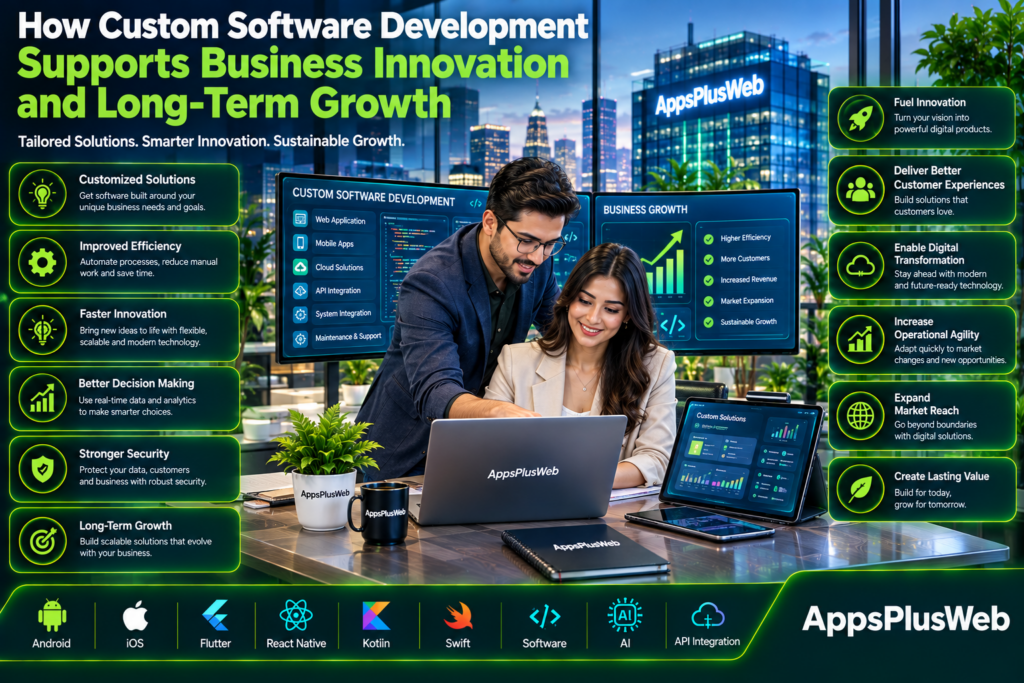
Businesses today need flexible digital solutions to manage operations, improve customer experiences, and respond to changing market demands. Traditional tools may work well during the early stages of a business, but growing organizations often require systems that match their specific workflows and long-term objectives. Custom software development helps businesses build technology around their operational needs, making it easier to manage information, coordinate teams, and improve productivity.
Working with a reliable software development company can help organizations transform business requirements into practical digital solutions. From automating repetitive tasks to connecting different departments through integrated platforms, customized software can support smarter decisions and more organized operations. AppsPlusWeb helps businesses explore digital solutions that align with their goals, customer expectations, and future development plans.
Understanding how custom software contributes to innovation allows business owners to make informed technology investments and establish a stronger foundation for sustainable growth.
Understanding Custom Software Development
Custom software development involves designing, building, testing, and maintaining applications according to the specific requirements of a business. Instead of adapting every process to a general-purpose product, organizations can develop software that supports their existing workflows and operational priorities.
These solutions can include customer relationship management systems, enterprise resource planning platforms, inventory management applications, booking systems, business dashboards, and industry-specific tools. The features depend on the organization’s objectives, users, budget, and technical requirements.
A customized platform can also connect with existing business applications, reducing the need to enter the same information into multiple systems. For example, an online retailer may integrate inventory management with order processing and customer notifications. This creates a more coordinated workflow and gives teams better visibility into daily operations.
The development process typically begins with requirement analysis, followed by planning, interface design, development, testing, deployment, and ongoing maintenance. A structured approach helps ensure that the final solution addresses real business needs and remains adaptable as those needs evolve.
Why Businesses Need Custom Software Solutions
Every organization has its own processes, customer expectations, and growth priorities. A standard application may provide useful features, but it may not accommodate every specialized requirement. Custom software gives businesses greater control over functionality, workflows, integrations, and future improvements.
One important advantage is operational alignment. Software designed around a company’s processes can help employees complete tasks more consistently and access relevant information without navigating unnecessary features.
Another benefit is improved data management. Businesses often collect information through sales platforms, customer support tools, accounting systems, and internal spreadsheets. Connecting these sources can create a clearer view of performance and reduce information gaps between departments.
Customized solutions can also support better customer service. Businesses can build portals, self-service systems, appointment platforms, and personalized dashboards that make interactions more convenient for their customers.
Security and access management are additional considerations. Depending on the solution, organizations can establish role-based permissions, monitoring processes, backup procedures, and appropriate data protection measures. These controls should be planned according to the sensitivity of business information and applicable legal requirements.
How Custom Software Encourages Business Innovation
Innovation becomes more practical when businesses have technology that supports experimentation and continuous improvement. Custom software can help organizations introduce new services, improve internal processes, and respond to changing customer needs.
For example, a service provider may develop an online booking platform that allows customers to schedule appointments, receive reminders, and manage their bookings. A manufacturing business might use a customized dashboard to monitor production information and identify delays. A distributor could implement a system that connects warehouse activities with order tracking.
These solutions can help businesses test new ideas without depending entirely on manual processes. Teams can review performance data, identify bottlenecks, and make informed adjustments based on actual usage.
Integration with analytics tools can further support innovation by revealing patterns in sales, customer behavior, and operational performance. Businesses can use these insights to improve product offerings, refine service delivery, and prioritize investments.
Artificial intelligence can also contribute when applied to suitable business needs. Depending on data quality and implementation requirements, AI-powered features may assist with document processing, customer support, forecasting, or information retrieval. Successful implementation requires appropriate testing, human oversight, and clear expectations about what the technology can achieve.
Key Benefits of Custom Software Development
Custom software can deliver several practical benefits when its features are aligned with measurable business objectives.
Improved productivity: Automated workflows can reduce repetitive administrative work and allow employees to focus on tasks requiring judgment, communication, and specialized skills.
Better collaboration: Shared dashboards, centralized records, and connected workflows can help teams coordinate activities and access consistent information.
Flexible functionality: Businesses can prioritize the features they need and introduce additional capabilities as their requirements change.
Enhanced customer experience: Customer portals, personalized services, and convenient digital interactions can make it easier for people to engage with a business.
Greater visibility: Reporting tools can help managers monitor operational indicators, identify performance gaps, and make better-informed decisions.
Integration opportunities: Custom applications can connect with existing systems through suitable APIs and other integration methods, creating a more coordinated technology environment.
Long-term adaptability: A well-planned software architecture can make future upgrades and feature additions easier to manage.
These benefits are not automatic. They depend on clear requirements, appropriate technology choices, effective implementation, user training, and ongoing maintenance. Businesses should establish measurable goals before development begins so they can evaluate whether the solution delivers meaningful results.
The Role of Mobile Apps in a Connected Business Ecosystem
Mobile applications have become an important part of many business strategies because customers and employees increasingly expect convenient access to digital services. When connected with custom business software, mobile apps can extend essential functions beyond the office.
A retail business may allow customers to browse products, place orders, track deliveries, and receive updates through an application. Field service teams may use mobile tools to access work assignments, update service records, and share progress with managers. Sales representatives can review customer information and update opportunities while meeting clients.
A mobile app development company can help organizations create applications that connect with backend software, databases, payment systems, and customer management platforms. The exact implementation depends on security requirements, device compatibility, integration needs, and the experience the business wants to provide.
When mobile applications and internal software work together, information can move more efficiently between customers, employees, and business operations. For instance, a service booking submitted through an app can be transferred to an internal scheduling system, helping staff manage appointments from a shared source of information.
Businesses should consider usability, accessibility, performance, data protection, and ongoing updates when planning mobile applications. These elements help create a reliable experience that supports both customer needs and organizational objectives.
How Automation Improves Business Efficiency
Automation allows businesses to reduce manual effort in repetitive, rule-based activities. Common examples include invoice generation, appointment reminders, order notifications, report preparation, lead assignment, and routine approval workflows.
When these tasks are handled through suitable software, employees may spend less time on repetitive data entry and more time on customer relationships, analysis, and strategic work. Automation can also improve consistency by applying the same defined process to recurring activities.
However, automation should begin with a clear understanding of the existing workflow. Automating an inefficient process without reviewing it first can preserve the same problems in a faster system.
Businesses should identify tasks that are frequent, time-consuming, and suitable for clearly defined rules. They can then introduce automation gradually, monitor results, and adjust workflows where necessary. Human review should remain available for exceptions, sensitive decisions, and situations that require context.
Custom Software for Scalability and Long-Term Growth
As an organization expands, its technology requirements often change. More customers, employees, transactions, locations, and services can increase the complexity of daily operations. Software designed with future needs in mind can help businesses manage this transition.
Scalable solutions may support additional users, larger datasets, new business locations, and expanded functionality. Depending on the project, suitable architecture, cloud infrastructure, database planning, and integration strategies can help accommodate increasing demand.
A growing business might begin with basic inventory and order management, then introduce supplier coordination, analytics, and multi-location reporting as operations expand. A service organization could add new appointment categories, customer portals, and staff management features over time.
Long-term growth also requires ongoing technical maintenance. Regular updates, performance monitoring, security reviews, backups, and compatibility checks help keep software useful and dependable.
Businesses should consider the total cost of ownership, including development, hosting, support, upgrades, and training. A realistic maintenance plan makes it easier to manage resources and prioritize improvements as business requirements evolve.
Choosing the Right Development Partner
Selecting a development partner is an important decision because the quality of planning and implementation influences the usefulness of the final product.
Businesses should begin by defining their objectives, target users, essential features, budget, and expected timeline. These details help potential partners understand the project and propose a suitable approach.
Review relevant project experience, technical capabilities, communication practices, testing procedures, and post-launch support. Ask how requirements will be documented, how progress will be reviewed, and how changes will be handled during development.
Security practices, code ownership, documentation, integration capabilities, and maintenance responsibilities should also be discussed before work begins. A clear agreement helps both parties understand deliverables and responsibilities.
AppsPlusWeb supports businesses exploring digital development solutions that align with their operational priorities and future plans. A well-organized development process should focus on solving real problems, delivering useful functionality, and creating a foundation for continued improvement.
Future Trends in Custom Software Development
Custom software continues to evolve as businesses adopt new technologies and seek more efficient ways to manage information. Artificial intelligence, cloud-based platforms, low-code development tools, and connected digital services are influencing how organizations plan and deliver software projects.
AI-assisted features may help automate selected tasks, summarize information, and support decision-making when implemented with appropriate safeguards. Cloud platforms can offer flexible infrastructure options, while APIs make it easier to connect different applications and services.
Cybersecurity is also becoming increasingly important. Businesses need to consider secure development practices, access controls, software updates, data protection, and ongoing monitoring throughout the application lifecycle.
Another important direction is user-centered design. Software must be understandable and practical for the people who use it every day. Simple interfaces, accessible experiences, reliable performance, and effective training can improve adoption.
Organizations should evaluate new technologies based on business value, implementation costs, security, and compatibility rather than adopting trends without a clear purpose.
Conclusion
Custom software development can help businesses improve productivity, strengthen collaboration, support innovation, and prepare for changing operational demands. By aligning technology with specific requirements, organizations can create workflows that serve employees and customers more effectively.
The strongest results come from clear planning, thoughtful design, appropriate integrations, reliable security practices, and ongoing maintenance. Businesses should identify their most important challenges, establish measurable objectives, and choose solutions that fit both current operations and future ambitions.
With a practical digital strategy and the right implementation approach, AppsPlusWeb can be part of a business’s journey toward more connected operations and sustainable digital growth.