
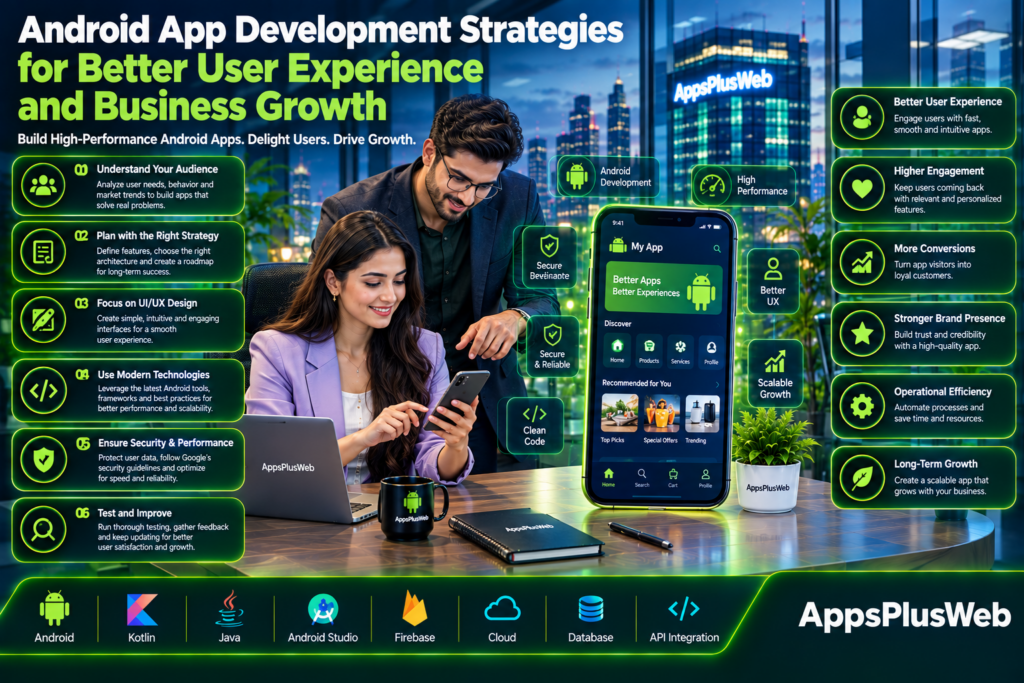
Introduction
Android applications have become an important part of how businesses connect with customers, deliver services, and manage digital operations. From online shopping and education to healthcare and financial services, mobile apps offer convenient ways to access information and complete everyday tasks. However, building a successful application requires more than attractive screens. Businesses need to consider usability, performance, security, accessibility, and long-term customer needs.
Working with a reliable mobile app development company can help businesses transform their ideas into practical Android applications that align with their objectives. A well-planned development strategy focuses on solving genuine customer problems, simplifying interactions, and creating a consistent digital experience.
AppsPlusWeb helps businesses explore technology solutions that support their digital goals. By combining thoughtful planning, user-focused design, and suitable development practices, organizations can create Android applications that strengthen customer relationships and support sustainable business growth.
Understanding Modern Android App Development
Android app development involves creating applications for devices running the Android operating system. These applications can support various business activities, including online transactions, customer communication, appointment scheduling, employee coordination, and digital content delivery.
The development process generally begins with requirement analysis. Businesses identify their target audience, define essential features, establish project priorities, and determine how the application will fit into their existing operations. Designers then create user interface concepts, while developers implement the application’s functionality and integrate the required systems.
Native Android development commonly uses Kotlin, with Java remaining relevant in many existing projects. Android Studio provides tools for writing code, testing applications, and identifying technical issues. Depending on project requirements, developers may also consider suitable cross-platform frameworks when businesses need applications for multiple operating systems.
Testing is essential throughout the development lifecycle. Teams should evaluate different screen sizes, operating system versions, network conditions, device capabilities, and accessibility requirements. This helps identify problems before the application reaches its intended audience.
A successful development approach balances business requirements with technical reliability. Careful planning also makes it easier to introduce new features and maintain the application as customer expectations change.
Why User Experience Matters in Android Applications
User experience influences how people interact with an application and whether they choose to continue using it. Even an app with advanced functionality may struggle to retain users if navigation is confusing, screens load slowly, or important actions require unnecessary steps.
A user-friendly Android application should make its primary functions easy to understand. Clear navigation, readable text, recognizable icons, and consistent layouts help users find information without frustration. Important actions, such as booking a service or completing a purchase, should follow a logical sequence.
Onboarding also deserves attention. New users should understand the app’s main benefits without being overwhelmed by lengthy instructions. When permissions are required, the application should explain their purpose before requesting access wherever appropriate.
Accessibility is another important consideration. Adequate color contrast, scalable text, descriptive labels, and support for relevant assistive technologies can make an application easier to use for a wider audience.
Businesses should evaluate user experience through usability testing, customer feedback, and application analytics. Metrics such as task completion rates, session duration, error frequency, and retention can reveal where improvements are needed.
Instead of adding features simply to make an app appear more advanced, businesses should prioritize functionality that makes customers’ lives easier. A focused, intuitive experience can support trust and encourage repeat engagement.
Essential Features of a High-Quality Android App
The right features depend on the application’s purpose, target audience, and business model. Nevertheless, several capabilities can contribute to a more useful and dependable experience.
Secure authentication: Login systems should protect user accounts while keeping access convenient. Depending on the application, businesses may consider multi-factor authentication, secure session management, and account recovery options.
Push notifications: Relevant notifications can communicate order updates, appointment reminders, important announcements, and service information. Users should have appropriate control over notification preferences, and businesses should avoid excessive messages.
Search and filtering: Applications containing products, services, articles, or listings should help users find relevant information quickly through useful search and filtering tools.
Payment integration: Shopping, booking, and subscription applications may require secure payment processing through suitable payment providers. The implementation should account for transaction status, failed payments, refunds, and confirmation messages.
Personalization: Relevant recommendations, saved preferences, and customized dashboards can make the experience more useful when they are based on appropriate data and transparent practices.
Analytics and reporting: Application analytics can help businesses understand feature usage, identify technical issues, and evaluate whether the product meets its objectives.
Backend integration: Connecting an app with inventory systems, customer records, booking platforms, or business databases can improve coordination and reduce duplicated work.
Every feature should serve a clear purpose. Prioritizing essential functionality first can help businesses control development costs, simplify testing, and gather feedback before introducing more complex capabilities.
Android App Development Strategies for Business Growth
Business growth depends on delivering value consistently rather than relying on technology alone. An Android application can support growth when its features address customer needs and connect effectively with wider business operations.
One useful strategy is to identify the most important customer journey. For an online retailer, this may involve product discovery, checkout, payment, and delivery tracking. For a service provider, it could include finding a service, scheduling an appointment, receiving confirmation, and contacting support.
Reducing friction across these steps can make the experience more convenient. Businesses should also ensure that their application communicates clearly when an action is completed, an error occurs, or additional information is required.
Another strategy is to connect the application with existing business systems. For example, integrating an app with inventory management can help maintain more accurate product availability. Connecting bookings with staff schedules can simplify appointment coordination.
Regular performance reviews can reveal opportunities for improvement. Businesses may evaluate customer feedback, conversion rates, app crashes, loading times, and feature adoption. These indicators help teams identify issues and prioritize updates.
A phased development approach can also support better planning. Businesses can launch a minimum viable product with essential features, evaluate real-world usage, and improve the application based on evidence. This reduces the risk of investing heavily in features that customers may not need.
The Role of Professional App Development Expertise
Professional development expertise helps businesses translate ideas into applications that are technically reliable and practical to maintain. A structured team can support requirement analysis, interface design, software architecture, coding, integration, testing, and deployment.
Clear project documentation is particularly valuable. When requirements, responsibilities, milestones, and acceptance criteria are defined early, stakeholders can review progress more effectively and reduce misunderstandings.
Businesses should also consider how the application will operate alongside their existing technology. API integration, database planning, authentication systems, and third-party services may all influence the project’s complexity.
For organizations evaluating a mobile app development company in Delhi, relevant experience, technical capabilities, communication practices, and post-launch support are important factors to assess. Location can support convenient collaboration, but the development partner’s ability to understand business requirements and deliver a dependable solution matters most.
Quality assurance should be incorporated throughout development rather than postponed until the final stage. Functional testing, performance checks, security reviews, and compatibility testing can help identify problems before they affect users.
After launch, teams should monitor application performance, review customer feedback, resolve defects, and plan updates. Ongoing collaboration helps keep the product aligned with changing requirements and operating conditions.
How Android Apps Improve Customer Engagement
Android applications provide businesses with direct digital channels for communicating with customers and delivering useful services. When designed around customer needs, these channels can make interactions more convenient and consistent.
Loyalty programs are one example. Businesses can provide reward tracking, membership benefits, and personalized offers through an application. Customers can review their progress without needing to contact support or manage physical membership cards.
Service-based businesses can offer appointment booking, reminders, status updates, and access to relevant information. Educational platforms may provide course materials, progress tracking, assessments, and learning notifications. These features make services easier to access while giving customers more control over their activities.
Feedback tools can also strengthen engagement. Short surveys, ratings, and support options help businesses understand customer concerns and identify areas for improvement. However, feedback requests should be timed thoughtfully and should not interrupt important tasks.
Personalized communication can be useful when it reflects genuine customer interests. Businesses should respect notification preferences, handle personal information responsibly, and avoid sending irrelevant promotional messages.
Engagement should be measured through meaningful indicators, such as repeat usage, customer satisfaction, successful task completion, and retention. High download numbers alone do not necessarily indicate that an application is delivering lasting value.
Security, Performance, and Scalability Considerations
Security is fundamental to an Android application’s reliability, especially when it handles personal information, payments, or business records. Development teams should use secure communication, appropriate access controls, protected credential storage, and reliable authentication practices.
Applications should collect only the information required for their intended functions. Privacy notices should explain relevant data practices, and businesses must consider applicable legal requirements when collecting or processing user information.
Performance also influences customer satisfaction. Developers can optimize images, reduce unnecessary network requests, manage background operations carefully, and monitor application crashes. Testing under different network conditions can help reveal issues that may not appear during development.
Scalability matters when an application attracts more users or introduces additional features. Appropriate backend architecture, database optimization, caching, and infrastructure planning can help accommodate increasing demand. The right approach depends on expected usage, data requirements, and budget.
Maintenance should include dependency updates, security reviews, compatibility testing, and backups where appropriate. Businesses should establish a process for monitoring issues and responding to problems after release.
These practices help create an application that is more dependable today and easier to improve in the future.
Choosing the Right Android App Development Partner
Selecting a development partner requires evaluating more than the initial project estimate. Businesses should consider whether a potential partner understands their industry, target audience, technical requirements, and long-term objectives.
Review previous projects and ask how the team approaches planning, design, testing, and deployment. Discuss the proposed technology stack, integration requirements, data protection measures, delivery milestones, and maintenance responsibilities before signing an agreement.
Transparent communication is equally important. Regular progress reviews, documented decisions, and clearly defined change-management procedures help keep a project organized.
When comparing mobile app development services, businesses should examine the scope of work, deliverables, testing standards, ownership arrangements, and post-launch support. The lowest quotation may not provide the best long-term value if essential requirements or maintenance costs are excluded.
AppsPlusWeb encourages a goal-oriented approach to digital development, with attention to business needs, user expectations, and practical implementation. The right partnership should provide a clear development process and a realistic plan for maintaining and improving the application.
Emerging Android App Development Trends
Android development continues to evolve as new tools and customer expectations influence application design. Businesses should evaluate emerging technologies according to their usefulness rather than adopting them simply because they are popular.
Artificial intelligence can support selected functions, including conversational assistance, personalized recommendations, document processing, and intelligent search. These features require suitable data practices, careful testing, and appropriate human oversight.
Cloud integration can help applications connect with shared business systems and support flexible infrastructure. Meanwhile, improved development tools and automated testing can help teams maintain code quality and identify defects earlier.
Privacy-conscious design is also increasingly important. Businesses should explain data collection clearly, request permissions appropriately, and protect information throughout its lifecycle.
Another continuing priority is accessible, responsive design that works across a range of Android devices. By monitoring technology developments and customer feedback, businesses can decide which improvements offer genuine value.
Conclusion
A successful Android application combines practical functionality, intuitive design, dependable performance, and strong security. Businesses that prioritize customer needs and define clear objectives can use mobile technology to improve service delivery, strengthen engagement, and organize daily operations more effectively.
Long-term results depend on thoughtful planning, careful testing, relevant features, and consistent maintenance. By reviewing performance and responding to user feedback, organizations can continue improving their applications as their requirements evolve.
AppsPlusWeb supports businesses exploring digital solutions that align with their goals. A well-planned Android development strategy can establish a stronger digital foundation and create meaningful opportunities for customer satisfaction and business growth.