
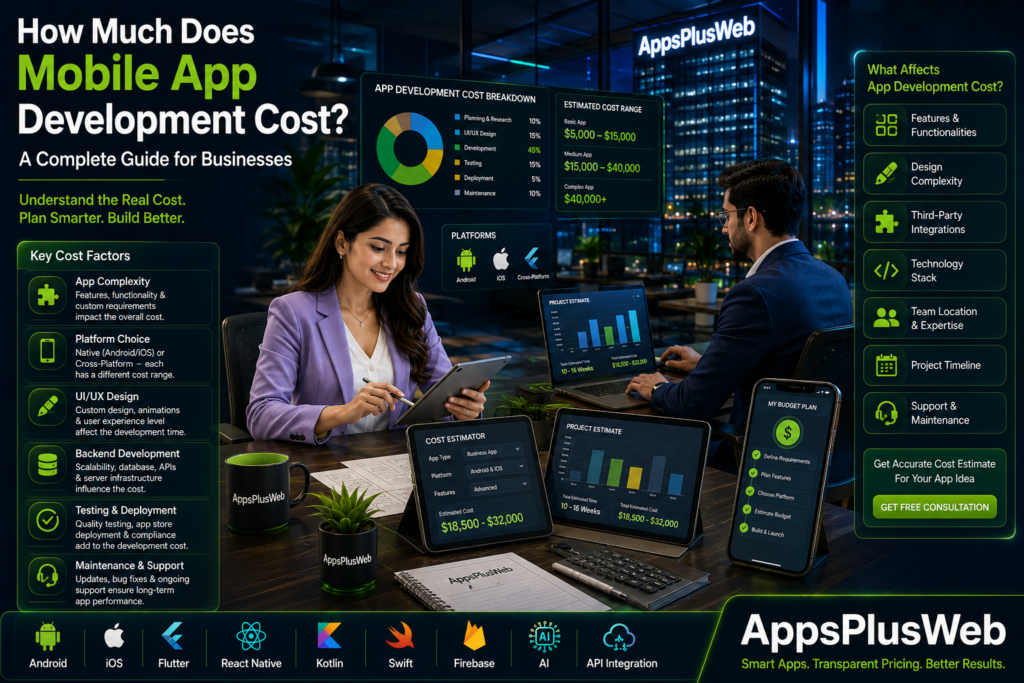
Mobile apps have become an important part of modern business growth. From startups and local businesses to established enterprises, companies are investing in mobile applications to improve customer engagement, simplify operations, and create new revenue opportunities. However, one of the first questions businesses ask before starting a project is: How much does mobile app development cost?
The answer depends on several factors, including app complexity, features, design, technology, development platform, integrations, security requirements, and ongoing maintenance. Choosing the right mobile app development company can also make a significant difference in planning the project budget and development process.
What Determines the Cost of Mobile App Development?
There is no single fixed price for every mobile application because every project has different requirements. A simple business application with basic features requires a different level of development compared with a large-scale application containing advanced functionality.
The main factors that influence development cost include the following:
1. Type and Complexity of the App
The type of application is one of the biggest factors affecting development costs. A basic information-based app may require fewer development hours, while an eCommerce platform, marketplace, booking application, fintech solution, or social networking app may require advanced features and backend systems.
Apps with multiple user roles, real-time communication, payment systems, location services, dashboards, and complex workflows generally require more planning and development.
2. UI/UX Design
A professional user interface and smooth user experience are essential for creating a successful mobile application. The design process may include wireframes, user journeys, prototypes, custom graphics, animations, and responsive layouts.
A well-planned UI/UX structure helps users navigate the application easily while creating a consistent brand experience across different screens and devices.
3. Android, iOS, or Cross-Platform Development
Businesses can develop applications for Android, iOS, or both platforms. Developing separate native applications can require additional resources because each platform may use different technologies and development approaches.
Cross-platform technologies such as Flutter and React Native can help businesses create applications for multiple platforms from a shared development approach. The right technology depends on the project’s objectives, functionality, performance requirements, and long-term roadmap.
4. Features and Integrations
The number and complexity of features directly influence the overall project budget. Common mobile app features include user registration, profiles, search, notifications, chat, booking systems, payment gateways, GPS, social login, analytics, and admin panels.
Applications may also need integrations with APIs, CRM systems, ERP platforms, cloud services, payment providers, AI solutions, or third-party business tools. Each integration requires development, testing, and security considerations.
Estimated Mobile App Development Cost
The development budget can vary significantly depending on the project scope. A basic application with essential functionality generally requires a smaller investment than a feature-rich enterprise application.
Instead of selecting a development company only according to the lowest quotation, businesses should evaluate the complete project scope, technology expertise, development methodology, communication process, testing standards, and post-launch support.
A professional mobile app development company in Delhi can help businesses define their requirements, select appropriate technologies, prepare a development roadmap, and estimate the project investment according to the desired functionality.
Why Choose a Professional Development Company?
Mobile app development involves much more than writing code. A successful project requires research, planning, UI/UX design, frontend development, backend development, API integration, quality testing, deployment, security, and ongoing improvements.
An experienced development team can help identify the most important features for the first release and create a scalable technical foundation for future upgrades. This approach can help businesses manage resources efficiently while keeping the application aligned with their business objectives.
How Businesses Can Control Development Costs
Businesses can take several practical steps to manage their mobile app development budget.
First, clearly define the target audience and primary purpose of the application. Next, prepare a list of essential features and prioritize them according to business value. Starting with a focused Minimum Viable Product (MVP) can help businesses launch important functionality first and introduce additional features in later versions.
Selecting the right technology stack is also important. A scalable architecture can make future improvements easier and help reduce unnecessary redevelopment.
Businesses should also include testing, security, hosting, maintenance, and future updates in their overall planning rather than considering only the initial development cost.
Why Delhi Businesses Are Investing in Mobile Apps
Delhi has a diverse business ecosystem covering retail, healthcare, education, finance, hospitality, real estate, logistics, professional services, and technology. Mobile applications provide businesses in these sectors with opportunities to connect with customers through convenient digital experiences.
A reliable mobile app development company in Delhi can create customized solutions based on local business requirements while also preparing applications for wider national and international audiences.
Conclusion
The cost of developing a mobile application depends on its complexity, features, design, technology, integrations, security requirements, and long-term support needs. There is no universal price because every business has different goals and technical requirements.
For businesses planning a new application, the best approach is to begin with a clear project scope and professional consultation. AppsPlusWeb helps businesses transform their ideas into modern, scalable, and user-focused mobile applications with solutions designed around specific business objectives.
Whether you are planning a startup app, eCommerce platform, enterprise application, booking solution, or AI-powered mobile product, selecting the right development partner can help you build a strong foundation for long-term digital growth.