
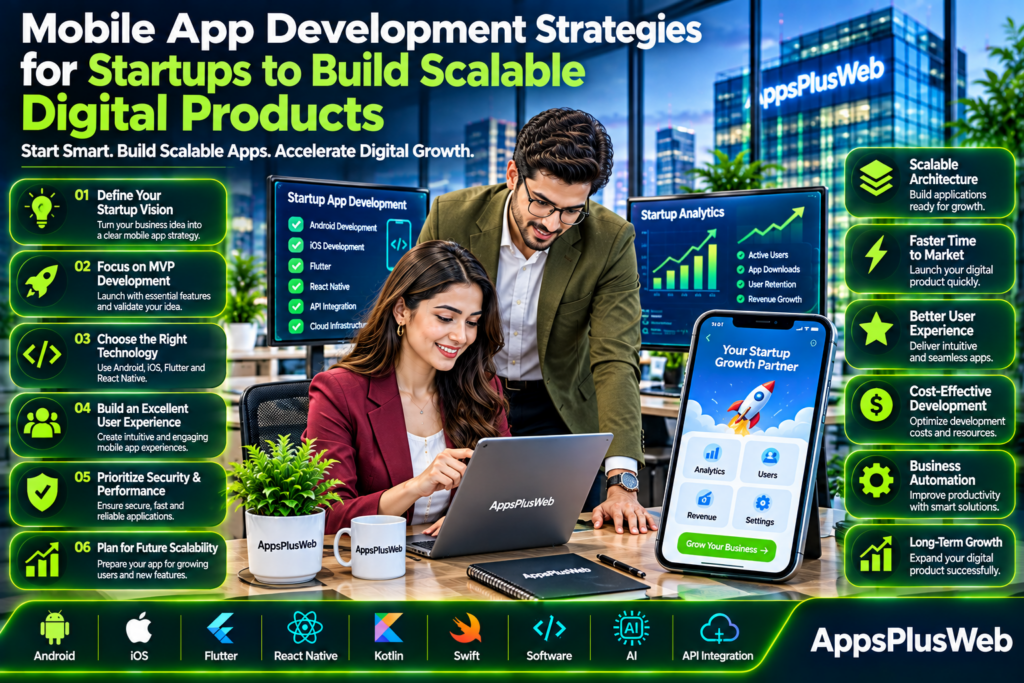
Introduction
Starting a new business involves several important decisions, and choosing the right digital technology is one of them. Mobile applications have become valuable tools for startups looking to introduce new products, connect with customers, simplify services, and establish a digital presence. However, building a successful application requires more than having an innovative idea. Startups need a clear development strategy, a defined target audience, suitable features, and a realistic investment plan.
Working with an experienced mobile app development company can help startups convert their business concepts into functional digital products. A structured approach allows entrepreneurs to prioritize essential features, select appropriate technologies, and prepare their applications for future expansion.
AppsPlusWeb focuses on digital development solutions that consider business requirements, user expectations, application performance, and long-term objectives. With proper planning, startups can create mobile applications that address real market needs and establish a foundation for sustainable digital growth.
Understanding Mobile App Development for Startups
Mobile app development for startups involves planning, designing, building, testing, and launching an application that supports a specific business idea. Unlike established organizations, startups often work with limited budgets and need to validate their concepts before making significant technology investments.
The first step is identifying the problem the application will solve. For example, a startup may want to create an online marketplace, a healthcare booking platform, an educational application, or a service management solution. Understanding the target audience and its expectations helps determine which features should be included in the initial version.
Startups should also evaluate the competitive landscape. Reviewing similar applications can reveal common features, customer complaints, usability gaps, and opportunities to introduce something different.
A well-defined development plan should include the project objectives, intended users, feature requirements, technology choices, estimated budget, and expected delivery stages. This makes the development process more organized and reduces the possibility of unnecessary features being added during implementation.
Why Startups Need a Clear App Development Strategy
A clear strategy helps startups manage resources and make informed decisions throughout the development process. Without proper planning, businesses may spend money on complicated functionality that does not address their customers’ primary needs.
One important consideration is product-market fit. Startups should understand whether their proposed application solves a genuine problem and whether potential users are interested in the solution. Customer interviews, surveys, competitor analysis, and prototype testing can provide useful insights before full-scale development begins.
Another consideration is feature prioritization. Every idea does not need to become part of the first release. Businesses should identify essential features that allow users to complete the main purpose of the application.
Budget planning is equally important. Development costs are influenced by application complexity, platform selection, interface design, backend requirements, integrations, and testing. Startups should also reserve resources for maintenance, hosting, updates, and customer support after launch.
A realistic strategy creates a balance between innovation, affordability, and technical quality.
MVP Development: Starting with Essential Features
A Minimum Viable Product (MVP) is an initial version of an application that includes the core functionality required to serve its primary purpose. It allows startups to introduce their concept to real users, collect feedback, and evaluate market response before investing in additional features.
For example, an online grocery startup may begin with customer registration, product listings, a shopping cart, payment integration, and order tracking. Advanced recommendations, loyalty programs, and detailed analytics can be introduced in later development phases.
An MVP offers several practical advantages:
- Controlled Investment: Startups can focus their initial budget on essential functionality.
- Faster Market Testing: A basic working product can be introduced without waiting for every planned feature.
- Customer Feedback: Real users can identify usability issues and suggest improvements.
- Reduced Development Risk: Businesses can evaluate assumptions before expanding the product.
- Flexible Improvements: Future features can be prioritized according to actual customer requirements.
An MVP should still meet appropriate standards for usability, security, and reliability. Releasing an incomplete or poorly tested application can negatively affect customer confidence. The objective is to build a focused product, not a careless one.
Choosing the Right Platform: Android, iOS, or Cross-Platform
Platform selection is an important decision because it affects development cost, technology requirements, testing, and the audience a startup can reach.
Android Development: Android applications can target a broad range of smartphones and devices. Startups may choose native development with Kotlin when they require platform-specific functionality, detailed device integration, or specialized performance.
iOS Development: iOS applications are developed for Apple’s mobile ecosystem. Swift is commonly used for native iOS development. Businesses targeting customers who primarily use Apple devices may consider launching an iOS application as part of their initial strategy.
Cross-Platform Development: Frameworks such as Flutter and React Native allow developers to build applications for multiple platforms using shared codebases. This approach may reduce duplicated development work, depending on the application’s features and technical requirements.
There is no single platform choice that suits every startup. The decision should depend on the target audience, available budget, required functionality, expected performance, and future expansion plans.
Essential Features Every Startup App Should Consider
The right features depend on the business model and the problem the application is designed to solve. However, several capabilities are commonly considered during mobile product planning.
User Registration and Login: Convenient account creation and secure authentication allow users to access personalized application features.
User-Friendly Dashboard: A clear dashboard should highlight important information and make frequently used actions easy to locate.
Search and Filters: Applications with products, services, or listings should provide effective search functionality so users can find relevant information quickly.
Push Notifications: Notifications can communicate order updates, booking confirmations, reminders, and important announcements. Users should have appropriate control over notification preferences.
Payment Integration: E-commerce, booking, and subscription applications may require secure payment processing through suitable payment providers.
Admin Dashboard: A management panel can allow business owners to monitor users, update content, manage transactions, and review application activity.
Customer Support: Contact forms, help sections, chat functionality, or support ticket systems can make it easier for customers to resolve issues.
Analytics: Application analytics can provide information about user activity, feature usage, retention, and technical performance.
Startups should select features according to their business priorities rather than copying every function offered by competing applications.
UI/UX Design and Customer Experience
User interface and user experience design influence how people understand and interact with an application. A visually attractive app may still perform poorly if customers cannot find important features or complete tasks easily.
The design process should begin with understanding the target audience. Different users may have different expectations regarding navigation, language, accessibility, and the amount of information displayed on each screen.
Simple layouts, readable typography, consistent colors, recognizable icons, and clear navigation can improve usability. Important actions should be easy to identify, and forms should request only the information necessary for their intended purpose.
Prototyping is useful before development begins. It allows startups to review screen layouts and user journeys without investing in the complete application. Usability testing can then reveal confusing elements and opportunities for improvement.
Applications should also be tested across relevant screen sizes and device conditions. An accessible and consistent experience can make the product more convenient for a wider audience.
Selecting the Right Development Partner
Choosing a development partner is an important step for startups that do not have an in-house technical team. The right partner should understand the business idea, evaluate technical requirements, and recommend a realistic development approach.
When evaluating a mobile app development company in Delhi, startups should review its project portfolio, technical capabilities, communication process, quality assurance practices, and experience with similar application requirements.
Businesses should ask how project milestones will be managed, how changes will be documented, and what testing procedures will be followed. It is also important to discuss source code ownership, documentation, security responsibilities, and post-launch maintenance before starting the project.
A detailed proposal should explain the features included in the scope, estimated timeline, payment schedule, technology stack, and expected deliverables. Comparing proposals based on their actual scope rather than price alone can help startups make a more informed decision.
AppsPlusWeb supports businesses exploring application development solutions with attention to project requirements, user experience, and practical technology choices.
Mobile App Development Cost for Startups
The cost of developing a mobile application varies according to its complexity, platform requirements, design, integrations, and development timeline. A simple application with basic features generally requires less investment than a platform containing real-time communication, advanced analytics, multiple user roles, and complex backend functionality.
The following are indicative estimates for the Indian market:
| Application Type | Estimated Cost |
| Basic App | ₹1.5 lakh–₹3 lakh |
| Medium-Complexity App | ₹3 lakh–₹7 lakh |
| Advanced App | ₹7 lakh–₹15 lakh or more |
These figures are planning estimates rather than fixed quotations. The actual investment depends on the project scope and implementation requirements.
Startups should also consider expenses beyond initial development. Hosting, domain services, third-party APIs, payment gateway charges, security updates, application maintenance, and marketing can contribute to ongoing costs.
A phased development model can make investment more manageable. Businesses can launch essential functionality first, evaluate customer feedback, and allocate additional budget to improvements that offer measurable value.
Security, Testing, and Application Scalability
Security and quality assurance should be considered from the beginning of a mobile application project. Startups may collect customer information, payment details, account credentials, and other sensitive data. Appropriate protection is necessary to maintain user confidence and reduce avoidable risks.
Development teams should consider secure authentication, encrypted communication, suitable access controls, protected data storage, and regular dependency updates. Applications should collect only the information required for their intended functionality.
Testing should cover functional behavior, device compatibility, performance, usability, and security. Real-world testing across different network conditions can reveal issues that may not appear in a development environment.
Scalability is another important consideration. As a startup gains customers, its application may need to support more users, transactions, and data. Suitable backend architecture, database planning, cloud infrastructure, and API design can make future expansion easier.
Regular maintenance, performance monitoring, backups, and software updates should be included in the long-term product plan.
Launching and Growing a Mobile Application
Launching an application is the beginning of its product journey rather than the final development milestone. Startups need a plan for introducing the product, attracting users, collecting feedback, and improving its functionality.
Before launch, businesses should prepare application store listings, screenshots, descriptions, privacy information, and support channels. A clear presentation can help potential users understand the application’s purpose and main features.
Marketing activities may include search engine optimization, content marketing, social media campaigns, email communication, and relevant partnerships. The selected channels should reflect the target audience and available marketing budget.
After launch, businesses should monitor downloads, active users, retention, customer feedback, crashes, and important conversion events. These indicators can help identify whether the application is meeting its objectives.
Regular improvements based on real usage data can strengthen the product over time. Startups should prioritize changes that improve customer experience, solve recurring problems, and support their wider business strategy.
Conclusion
Building a successful mobile application requires a combination of business planning, customer research, appropriate technology, and continuous improvement. Startups should begin with a clear problem to solve, prioritize essential features, select suitable development platforms, and establish a realistic budget.
An MVP can provide an effective starting point, while user feedback and application analytics can guide future development decisions. Security, testing, scalability, and maintenance should remain important throughout the product lifecycle.
Choosing suitable mobile app development services can support startups through planning, design, development, testing, deployment, and ongoing improvements. With a practical strategy and a strong focus on customer needs, AppsPlusWeb can be part of a startup’s journey toward building scalable digital products and establishing a stronger online presence.